
Beloved for their festive charm, candle carousels are a staple of holiday décor, especially in German Christmas traditions. These captivating ornaments feature a series of candles placed on a rotating platform, with metal blades that gently spin the candles as they burn. But how do these magical decorations seem to turn on their own?
The secret lies in a basic scientific principle called convection current and its subtle magic.
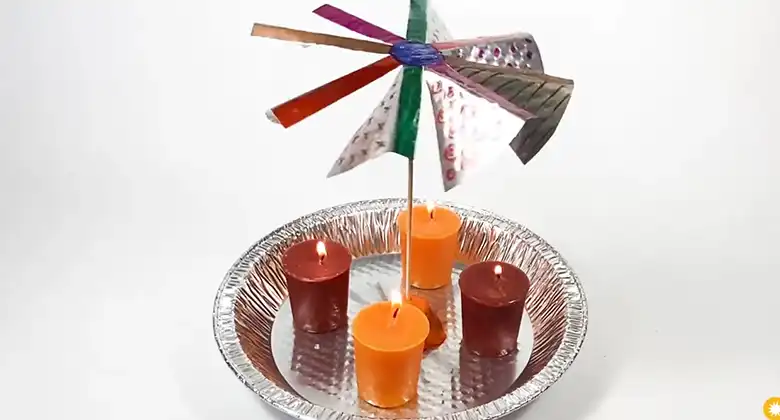
How Candle Carousels Spin: The Science Behind the Spin?

Convection Explained
The self-spinning motion of candle carousels relies on the power of convection currents. Convection is the cycle of heating and cooling that causes circulation in fluids like air. It works on the principle that hot air rises while cool air sinks. The candles warming the air around them create these currents. As the air near the flame heats up, it becomes less dense and rises upward. Meanwhile, the cooler, denser air sinks down to take its place, creating a continuous circulation. This movement of air is used to propel many things like hot air balloons.
Power of the Blades
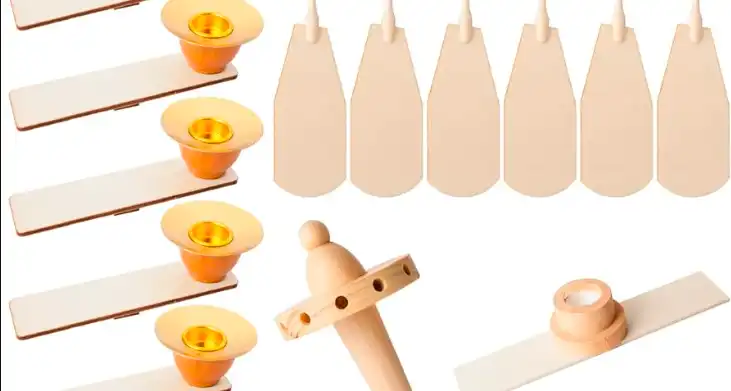
Candle carousels leverage convection through strategically placed blades above the candles. These blades are designed at angles that allow the rising warm air to push against them with maximum force. As the heated air from the candle flames rises, it bumps into the tilted blades causing them to spin around their center axis. This is similar to how airplane wings and propeller blades are engineered for optimal lift and thrust. The spinning blades in turn drive the rotating platform below.
Spinning Into Action
Once the first push of hot air sets the blades moving, a self-sustaining cycle kicks in. The motion of the spinning blades helps circulate the air, bringing a regular stream of fresh cool air to the candles. This creates a continuous supply of rising warm air that bumps the blades, keeping the spin going. The distribution of weight and balance across the carousel also allows it to spin smoothly and steadily. Some designs even allow reversing the blade angles to switch the direction of rotation.

What Affects the Spin?
There are a few key things that can affect candle wick spin:
Number of Candles

More candles generate increased heating and stronger convection currents. This leads to faster spinning. Testing a carousel with varying numbers of candles illuminated produces noticeably different rotation speeds.
Blade Design and Angle
Subtle variations in blade shape and angle alteration also impact the speed and spin direction. Blades crafted for greater lift and slanted to receive an optimal convection push will spin the carousel more powerfully. Testing blades set at incrementally different angles clearly demonstrates the effect on rotation velocity.
Environmental Conditions
Air currents in the surroundings as well as the altitude can influence the intensity of the convection currents. This in turn impacts the spinning. Experimenting with the same carousel setup in different environments could produce noticeably different spin behavior.
Historical and Cultural Significance of Candle Carousel
Candle carousels have an intriguing history, tracing back to 1800s Europe. The spinning motion originated from candle-heated convection toys. They surged in popularity as festive decorations in Germany, acquiring deep cultural significance in Christmas traditions. Different directions of spin even took on symbolic meaning about the year ahead.
How To Make Your Own Candle Carousel?
Now that you understand the science behind how candle carousels work, you can try building your own! With a few basic supplies and these steps, you’ll be on your way to engineering a spinning ornament.
Supplies Needed
- Plywood or thick cardboard for the base
- Metal or wooden rod for the axle
- Plastic or metal blades/arms to attach candles
- Tea lights or votive candles
- Craft decorations like bells, ribbons, glitter, etc.
- Glue gun, drill, pins, scissors, etc.
Ste-by-Step Instructions
- Cut plywood into a circle or square shape for the base. Drill a hole through the center for the axle.
- Insert the metal rod axle through the base and secure in place with glue or clamps.
- Cut blades out of cardboard at an angle. Hole punch the bottom and attach them evenly spaced around the axle using pins.
- Glue tea lights or votives in candle holders onto the ends of each blade.
- Decorate the base, blades, and candles with craft materials as desired.
- Light the candles, give the carousel a gentle spin, and watch your design go!
- Adjust the blade angles as needed to generate a smooth, continuous spin.
Tips
- Ensure the base is properly balanced to spin evenly.
- Angle blades between 45-60 degrees for optimal lift.
- Start with 3-5 blades and add more once the spin is established.
- Keep away from drafty areas to maintain steady air currents.
Have fun designing your own whimsical candle carousel and learning science hands-on! The spinning and flickering creation will make a beautiful festive decoration.
Final Words
Candle carousels have delighted people for generations because science and enchantment harmoniously unite through their mesmerizing spin. Simple physics keeps the flickering lights in perpetual motion while evoking cozy celebration. As convection currents move the meticulously angled blades, which in turn rotate the candles, beauty and tradition spin on. These magical ornaments demonstrate the hidden wonders that can emerge when fundamental forces work their subtle magic.
Frequently Asked Questions
How fast do candle carousels spin?
Spin speeds vary, but generally, carousels complete 1-3 revolutions per minute. Larger ones with more candles may spin faster than smaller models.
Can the spinning go in both directions?
Yes, reversing the angle of the blades will change the direction of spin, since the convection currents will now push the other way.
Why are candle carousels so popular in Germany?
They became a part of German Christmas tradition in the 1800s when crafters first created the spinning candle ornaments. Their festive appeal endures as part of holiday decorating custom.
Is it safe to leave a candle carousel spinning unattended?
It’s best not to leave any open flames unattended. But as long as basic fire safety rules are followed, a spinning carousel under supervision should not pose any unique hazards.
How can I make a DIY candle carousel?
There are many online tutorials for creating your own carousel using materials like popsicle sticks, pins, candles, and embellishments. Basic construction is straightforward, but experimenting with blade angles takes some trial and error.